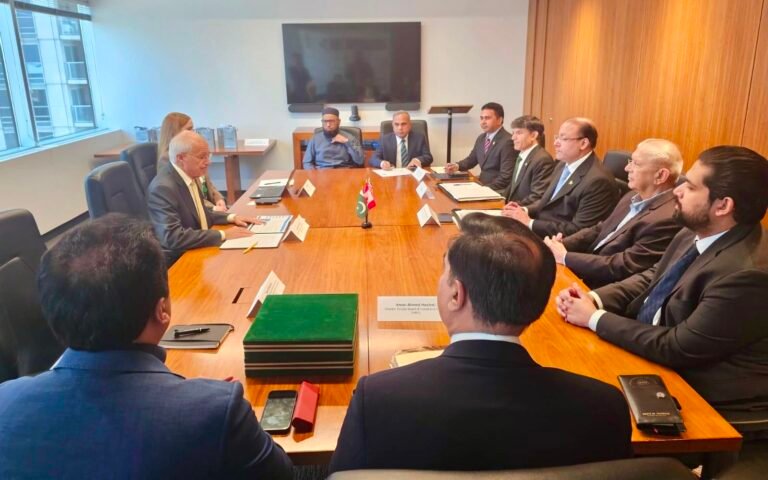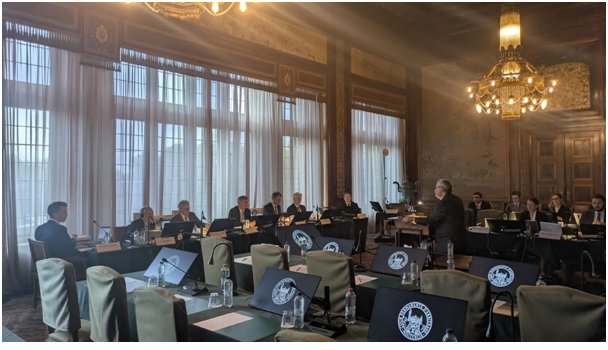
On 31 August 2026, the Court of Arbitration rendered: (i) an Award on the Status of the Indus Waters Treaty in Respect of India’s Decision on Abeyance(“Award on Treaty Status”); and(ii) an Order on the Interim Measures Application of Pakistan dated 4 March 2026 (“Order on Interim Measures”),in the Indus Waters Western Rivers Arbitration initiated by the Islamic Republic of Pakistan(“Pakistan”) against the Republic of India (“India”) pursuant to Article IX and Annexure G of the Indus Waters Treaty.
In these proceedings, Pakistan requests the Court of Arbitration to address the design of certain components of the run-of-river hydro-electric projects that India is permitted by the Indus Waters Treaty to construct on the Indus, Jhelum, and Chenab Rivers and their tributaries (“Western Rivers”), before those rivers flow into Pakistan. The proceedings concern the interpretation and application of the Indus Waters Treaty as a general matter, as well as in the context of two specific Indian projects: the Kishen ganga Hydro-Electric Plant (“KHEP”) and the Ratle Hydro-Electric Plant (“RHEP”). The KHEP and RHEP projects are also the subject of proceedings before a Neutral Expert, a highly qualified engineer appointed by the World Bank.
In the Award on Treaty Status, the Court considered the present status of the Indus Waters Treaty, in light of India’s decision in April 2025 to hold the Treaty “in abeyance” following an attack in India-administered Jammu and Kashmir. The Court considered the meaning of India’s decision, finding that it could only be a claim that the Indus Waters Treaty is either suspended or terminated. The Court examined the potential grounds upon which India could suspend or terminate the Treaty, including the grounds cited by India in its public statements. In a unanimous decision, the Court found that none of these grounds could justify suspension or termination of the Treaty. Accordingly, the Indus Waters Treaty remains fully in force, and India must observe its obligations under the Treaty, including those relating to the design and operation of its hydro-electric projects on the Western Rivers.
In the Order on Interim Measures, the Court considered a request from Pakistan for the imposition of measures limiting construction works at the RHEP pending the Neutral Expert’s decision on whether the RHEP design complies with the Treaty. In a unanimous decision, the Court decided to impose measures prohibiting India from concreting the RHEP dam wall and power in take structure above certain levels until 90 days after the Neutral Expert’s final decision, which is expected in July 2027.TheCourt also imposed a reporting measure relating to the RHEP Construction Schedule until shortly after the Neutral Expert’s final decision. The Court declined to grant two other measures requested by Pakistan.
An expanded summary of the Court’s decisions is set out below .The Court’s decisions will be published on the website of the PC Aafter completing a process with the Parties to identify confidential information for redaction.
The Court of Arbitration is chaired by Professor Sean D. Murphy of the United States. The other members are Professor Wouter Buytaert of Belgium, Professor Jeffrey P. Minear of the United States, Judge Awn Shawkat Al-Khasawneh of Jordan, and Dr. Donald Blackmore of Australia.
Pursuant to a decision by the Court of Arbitration, the PCA acts as the secretariat for the proceedings.
BackgroundonthePermanentCourtof Arbitration
The Permanent Court of Arbitration is an intergovernmental organization established by the 1899 Hague Convention on the Pacific Settlement of International Disputes. The PCA has 129 Contracting Parties. Headquartered at the Peace Palace in The Hague, the Netherlands, the PCA facilitates arbitration, conciliation, fact-finding, and other dispute resolution proceedings among various combinations of States, State entities, intergovernmental organizations, and private parties. The PCA’s International Bureau is currently administering five inter-state arbitrations, one inter-state conciliation, one other inter-state proceeding, 90 arbitrations arising under bilateral or multilateral invest menttreaties or national investment laws, 103 arbitrations arising under contracts involving a State or other public entity, and 10 other proceedings. More information about the PCA can be found at www.pca-cpa.org.
About the Author